Products
Screen Inks for Glass Printing
Two-component and UV-curable screen inks that bond to glass through silane chemistry and survive the dishwasher.
Home › Products › Screen Printing Inks › Screen Inks for Glass Printing
Overview
Printing on glass substrates
High-adhesion, high-scratch-resistance silk-screen printing inks in single-pack and two-pack systems for printing on glass substrates, used in cosmetics, spirits, tableware and industrial applications.
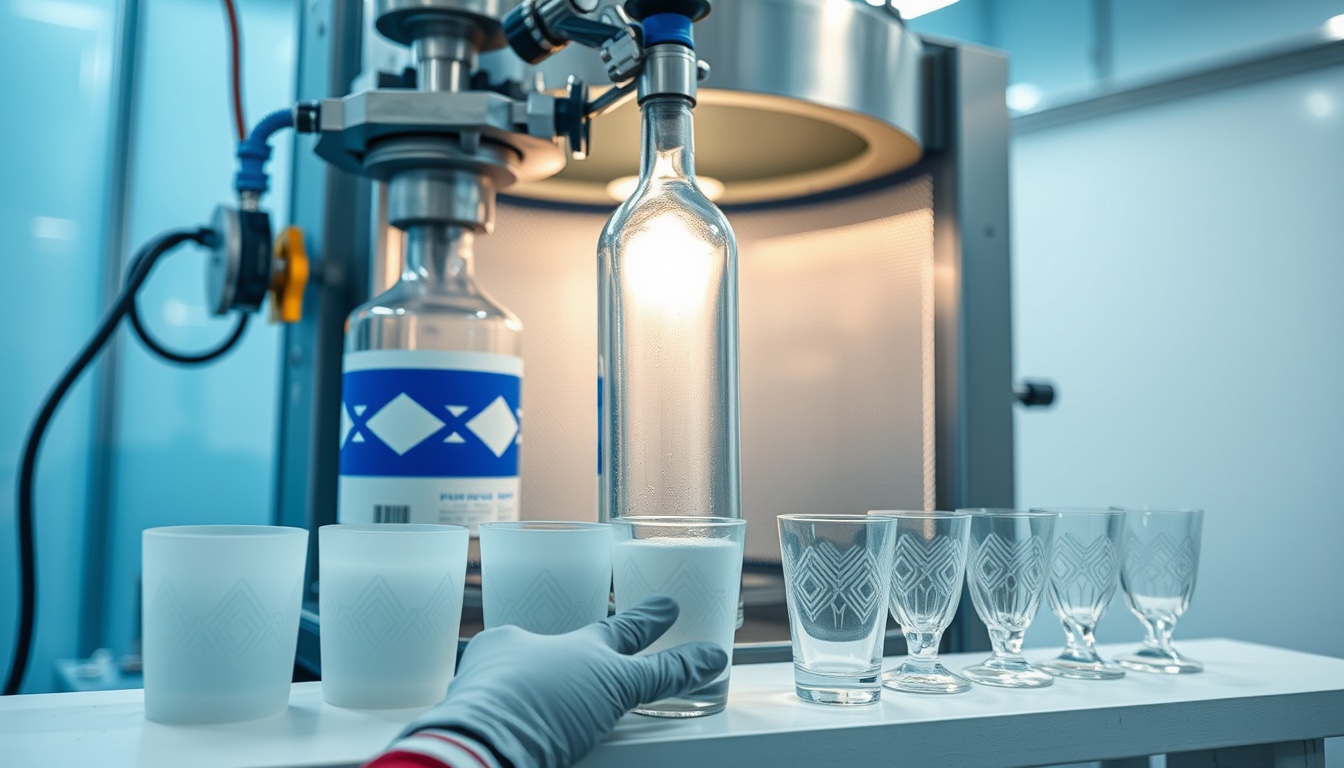
Our UniScreen-35 two-component glass inks form a silane bridge that bonds the ink to the glass itself — and it shows in the dishwasher.
Grades in this series
UniGlazier 833SB
Two-pack solvent-based screen inks for flat glass.
SCure-66UV
Single-pack UV curable screen ink for glass printing.
SCure-72UVLED
Two-pack UV LED curable screen ink for glass printing.
UniScreen-35
Two-component glass ink with silane bonding technology.
White paper
Why glass rejects conventional inks
A clean glass surface carries silanol (Si–OH) groups and an adsorbed water layer. Organic binders — acrylics, polyesters, epoxies — cannot form covalent bonds to this surface on their own; they rely on physical adhesion, which fails as soon as water reaches the interface. Water diffuses through every organic film, hydrates the silanol layer and lifts the ink. This is why a print that passes a tape test on day one fails after a week in a humid warehouse or a single dishwasher cycle.
The second problem is stress. Glass does not move; cured ink films shrink. A rigid, highly cross-linked film stores its cure shrinkage as interfacial stress that thermal cycling or impact releases as flaking.
Coupling-agent chemistry. Organofunctional silanes are the bridge. A silane such as an amino- or epoxy-silane carries alkoxy groups on one end that hydrolyse to silanols and condense with the glass surface to form Si–O–Si bonds, and an organic functional group on the other end that reacts with the ink binder. The result is a covalent chain from glass to polymer that water cannot displace. The silane must reach the glass, so the surface must be free of oils, release agents and the tin-side residue of float glass.
Downloads
Technical documents
Download the Technical Data Sheet, Safety Data Sheet and Regulatory Summary for every product in this range. Technical data sheets are provided as standard for all Uniform Industries printing inks and coatings.
| Product | Description | Documents |
|---|---|---|
| SCure UV Screen Inks for Glass | Single-pack and two-pack UV and UV LED curable screen inks for glass printing | TDSSDSRegulatory |
| UniGlazier 833SB | Two-pack screen inks for flat glass | TDSSDSRegulatory |
TDS = Technical Data Sheet. SDS = Safety Data Sheet (MSDS) according to Regulation (EC) 1907/2006 Annex II and UN GHS. The Regulatory Summary lists the compliance status of each product. Click a document to read it online in the viewer; each document can also be downloaded as PDF (up to 5 downloads per location). Product catalogues are available to read online. For a controlled copy, a declaration of compliance for your specific application, or documents for a product not listed here, write to sales@ufindustries.com.
Don't see what you're looking for?
Please feel free to call us. We colour-match to any request and develop inks around your press-room need.

Science Technology Innovation & Application. Printing inks and coatings for packaging, label and graphic printing since 2006.
Contact Us
E105, GNEPIP, Industrial Area Site-5,
Greater Noida, Uttar Pradesh 201306, India
+91-8750051884
sales@ufindustries.com
https://ufindustries.com