Products
Unimax 400
A UV offset ink series formulated for LED arrays at 385–405 nm, for sheet-fed and narrow-web offset, with a low-migration variant.
Home › Products › UV Offset Inks › Unimax 400
Products › UV Offset Inks
An LED offset ink is a different formulation, not the same ink under a different lamp
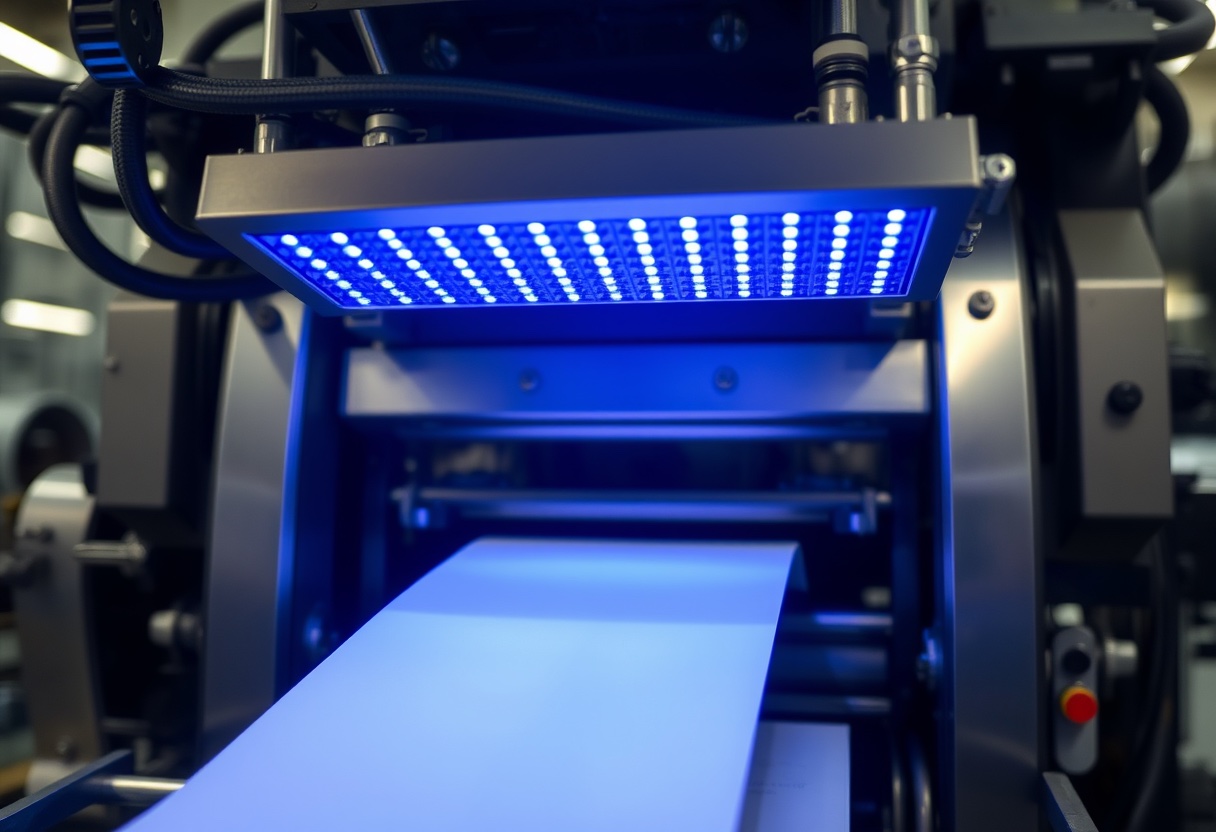
Unimax 400 is cured by light-emitting diodes emitting between 385 and 405 nm. That one fact sets the whole formulation. A medium-pressure mercury lamp emits a broad spectrum from 200 to 450 nm, with strong lines at 254, 313 and 365 nm, so a conventional UV ink has several places to absorb. An LED array emits one narrow band and nothing else. Any absorption the initiator package has outside that band is wasted. An ink built for mercury, placed under an LED array, does not cure more slowly: very often it does not cure at all, because the initiator has almost no absorption where the lamp emits. Unimax 400 is built from the lamp backwards. The photoinitiator package absorbs at 385–405 nm, and the oligomer and monomer backbone is matched to the radical yield that package delivers. TPO, the initiator the industry used for this job for years, is excluded across our range: it has been reclassified as reprotoxic category 1B under CLP by the 19th ATP, applying from September 2025, and it sits on the EuPIA Charter exclusion list. In its place we use higher-molecular-weight and multifunctional acylphosphine oxides, chosen for absorption in the same near-UV window and for the fact that what they leave behind after cure is larger, and therefore slower to move through a film, than a small-molecule fragment.
The second consequence is the direction of cure. Short-wave mercury light is absorbed in the top micrometre of the film, so a mercury-cured ink cures from the surface down, and the short wavelengths are what overcome the oxygen inhibition sitting at the air interface. There is no short-wave component in an LED array. Light at 385–405 nm penetrates the whole film, so cure starts near the substrate and works upwards, and the surface is the last part to finish. The surface is also where atmospheric oxygen quenches radicals as fast as they form. Surface cure under LED is therefore a race: radical flux against oxygen diffusion. Winning it needs peak irradiance at the film rather than accumulated dose alone, a short and constant lamp-to-substrate distance, and a co-initiator system chosen to keep flux high. Opaque white and dense black remain the limiting colours and set the lamp requirement for the job.
What the press gains is worth the reformulation. There is no mercury in the lamp, so no lamp disposal route and no breakage procedure. There is no short-wave emission, so no ozone and no extraction duct dedicated to removing it. There is almost no infra-red, which is the change a sheet-fed printer notices first: heat-sensitive board, synthetic paper and thin plastics come off the press flat, moisture is not driven out of the sheet, curl and register drift fall away, and substrates previously ruled out by lamp heat become printable. The array switches on and off instantly, with no warm-up, no shutter and no standby, so a press that stops between jobs stops consuming. Electrical draw is a fraction of a mercury installation, and emitter life is rated in tens of thousands of hours against the one to two thousand hours of a medium-pressure mercury lamp.
What the printer must get right is short and unforgiving. Lamp-to-substrate distance: LED arrays are near-field sources and irradiance falls sharply with distance, so the working distance the array maker specifies is the one to hold, and a few extra millimetres of clearance can cost surface cure. Irradiance and dose measured in band, with a radiometer calibrated for 385–405 nm, because a radiometer set up for mercury will report a number that means nothing here. Ink film weight, typically 1.0 to 1.5 g/m² for solids on offset: a heavier film cures deep but finishes late at the surface, so over-inking shows up as surface tack, not as an uncured base. And water balance, because dampening solution carried into the ink emulsion depresses both cure and gloss. Cure is a dose, not a switch. Under-cure leaves unreacted monomer and initiator in the film, which is a migration problem on packaging and an adhesion and resistance problem everywhere else.
Grades in this series
Variants of Unimax 400, all on the same 385–405 nm initiator platform, so a colour match or a grade change does not change the cure window. The variant names match the range list on the UV offset inks page.
Unimax 400 Process
UMX-401 to UMX-404
Unimax 400 Bases
UMX-411 to UMX-425
Unimax 400 Opaque White
UMX-405
Unimax 400 NW — Narrow Web
UMX-400NW
Unimax 400 LM — Low Migration
UMX-400LM
Product data
| Process | Sheet-fed offset at 8 000–18 000 sheets/h, and the offset decks of narrow-web combination presses at 30–100 m/min on the NW grade. Conventional, alcohol-reduced and alcohol-free dampening. |
|---|---|
| Cure | LED arrays at 385–405 nm. Peak irradiance at the sheet 8–12 W/cm² for process colours and mixing bases, 12–16 W/cm² for opaque white and dense black. Dose 80–150 mJ/cm² for process and bases, 150–250 mJ/cm² for opaque white and dense black, measured in band at the substrate plane with a radiometer calibrated for 385–405 nm. Hold the array working distance the maker specifies, typically 5–15 mm sheet-fed and 2–8 mm interdeck; 5 mm beyond that gap typically costs 15–30 % of peak irradiance. |
| Substrates | Gloss- and matt-coated paper and board, cast-coated and metallised board, folding carton board, uncoated and recycled board at a heavier film, synthetic paper, and treated or primed plastics — PP, PE, PET, rigid PVC and styrene sheet — at a surface energy of 40–44 mN/m. Adhesion confirmed by cross-hatch and tape pull 24 hours after the run, not at the delivery. |
| Film weight | 1.0–1.5 g/m² for process solids on coated board, about 1.0–1.5 µm of cured film; 1.5–2.0 g/m² on uncoated and absorbent stock; 1.8–2.5 g/m² for opaque white; 0.8–1.2 g/m² on the NW grade. |
| Tack and viscosity | Bench tack 13 ± 2 for a single mid-sequence ink (IGT tackmeter, 400 rpm, 30 °C, 1.3 cm³ charge, read at 60 s — the house charge across every sheet in the range). The ladder is a separate specification, set to descend 1–2 points per unit for wet-on-wet trapping: typically 14–16 first down and 10–12 last down, each grade supplied on its own tack rather than on the bench value. Viscosity 45 ± 10 Pa·s with a yield value of 150 ± 50 Pa, falling-rod (Laray) viscometer at 25 °C and 2 500 s⁻¹. NW grade: bench tack 10 ± 2, ladder 11–12 down to 8–9, viscosity 35 ± 8 Pa·s with a yield value of 100–200 Pa on the same methods. |
| Colour range | Four-colour process set UMX-401 to UMX-404, opaque white UMX-405, dense black UMX-406, fifteen mixing bases UMX-411 to UMX-425 and blending varnish UMX-426. Shades matched to a customer standard, a drawdown or a published colour reference. Light fastness is read on the full-tone, unvarnished film at 1.0–1.5 g/m² by filtered xenon arc to ISO 12040 against the ISO 105-B02 blue wool references: process set 4–5 (yellow), 4–5 (magenta), 8 (cyan) and 8 (black). Among the bases the ratings follow the pigment class rather than one band: Reflex Blue UMX-420 is 5–6, Purple UMX-418 and Violet UMX-419 are 4–5, and Rhodamine UMX-417 is 2–3. Tints and process builds lose one to two steps. |
| Photoinitiator system | Built for the 385–405 nm band on high-molecular-weight and multifunctional acylphosphine oxide chemistry with amine synergists for surface cure. TPO is excluded from every grade — reprotoxic category 1B under CLP by the 19th ATP, applying from 1 September 2025, and on the EuPIA Charter exclusion list. The LM grade uses polymeric amine synergists in place of free amines and excludes ITX and benzophenone. |
| Excluded | TPO across the series; ITX and benzophenone in the LM grade; heavy metals; mineral oils; aromatic hydrocarbon solvents; solvent and water of any kind. |
| Low-migration grade | Unimax 400 LM — the LM suffix on any shade, for example UMX-405LM, and UMX-405NW-LM where the narrow-web and low-migration platforms combine. Photoinitiators chosen for low mobility, polymeric amine synergists, monomer selection weighted to higher-functionality acrylates. Conformity of a finished pack is established by a migration assessment on that pack, at the specified dose and film weight, on the actual substrate and with set-off controlled; assessed on the pack, on request. No migration figure is published as a measured result. |
| Cure check | On the heaviest solid within one minute of the final array: surface twist under firm thumb pressure with a 90° twist — no marking, no smearing, no fingerprint and no matting of the gloss. Within five minutes: at least 20 IPA double rubs with a cotton pad under about 1 kg hand load, no colour on the pad. At 24 hours, after the dark reaction: at least 50 MEK double rubs on process solids and at least 30 on opaque white, and cross-hatch adhesion typically classification 0–1 to ISO 2409 with a tape pull — class 1 being detachment of not more than 5 % of the lattice area, which is what 0–1 means. The cross-hatch is a check on the job in hand rather than a guaranteed property: adhesion is confirmed by trial on the customer’s own substrate 24 h after the run. Residual acrylate odour is under-cure; cracking on the crease is over-cure. |
| Pack sizes and shelf life | 1 kg and 2.5 kg tins, 2 kg cartridges for automatic ink feed, and 5 kg and 20 kg pails on process colours; 1 kg cartridges and 2 kg tins on the NW grade. Shelf life 9 months from date of manufacture in the unopened original container at 15–25 °C, out of daylight and stray array light — the long-wave initiator package absorbs in a band that daylight contains, so light exclusion is a storage condition, not a precaution. |
| Documentation | Technical Data Sheet, Safety Data Sheet and Regulatory Summary with every delivery, for every grade in the series. |
Compliance and standards
- Raw materials selected to the EuPIA Charter
- TPO-free
- ITX- and benzophenone-free in the LM grade
- Heavy-metal-free pigments
- Low-migration grade available
- Migration assessment on request
- REACH-registered raw materials
White paper
Why a mercury ink does not cure under an LED array
Photoinitiation is an overlap problem. The initiator absorbs over a particular range of wavelengths, the lamp emits over another, and only the product of the two produces radicals. A medium-pressure mercury lamp gives the formulator a broad target: lines at 254, 313 and 365 nm and a continuum between them. An LED array gives one band, 385 to 405 nm, with steep sides. An initiator package tuned to 254 and 313 nm sees almost no photons from it. The ink stays wet, and no increase in exposure time fixes a wavelength that is not being absorbed.
The missing short wavelengths also remove the mechanism that cures the surface. Short-wave light is absorbed within the top micrometre, so under mercury the surface receives the highest photon density and cures first, in spite of the oxygen dissolved there. Near-UV at 385–405 nm passes through the film with far less attenuation, so the deepest layers see nearly the same intensity as the top. Cure therefore develops from the substrate upwards and the air interface finishes last, at exactly the place where oxygen intercepts radicals and converts them into unreactive peroxy species. The remedy is flux, not time: enough radicals generated per unit time at the surface to consume the dissolved oxygen faster than more can diffuse in. That is why peak irradiance at the film, and the distance that controls it, matter more under LED than under mercury, and why a slow pass under a weak array can leave a film that is hard underneath and tacky on top.
Pigment changes the arithmetic again. Yellow is relatively transparent in the near-UV and cures readily. Dense black competes directly with the initiator for the same photons. Titanium dioxide has a refractive index far above that of the binder, so it scatters light strongly — that is where its opacity comes from — and the scattering shortens the effective path of light into the film. Rutile grades also absorb below their band edge at around 405–410 nm, so at 385–395 nm the pigment takes a share of the output as well as scattering it. White is therefore the hardest colour in any LED series, and the answer is longer-wavelength emitters at 395 or 405 nm and more peak irradiance, not more of a shorter wavelength the pigment absorbs. Specify the lamp for the white and the black; the rest of the set will follow.
The initiator chemistry itself is constrained by more than absorption. TPO absorbs well in the LED band and was the standard choice, but its reclassification as reprotoxic category 1B under CLP by the 19th ATP, applying from September 2025, and its place on the EuPIA Charter exclusion list removed it. Unimax 400 uses higher-molecular-weight and multifunctional acylphosphine oxide chemistry instead, selected to absorb in the same region at greater molecular weight. On the low-migration variant the initiator carries reactive groups so that it binds into the network during cure rather than remaining a mobile residue, and the amine synergists used to relieve oxygen inhibition are replaced by polymeric, amine-free co-initiators.
White paper
Setting an LED offset job: distance, irradiance, film weight and the cure check
Start at the array. LED emitters are near-field sources, and irradiance at the film falls quickly as the gap opens. Hold the working distance the array manufacturer specifies and keep it constant across the web or sheet width; a guard, a worn bearer or a lifted sheet edge that adds a few millimetres will show first as surface tack on the heaviest solid. Measure in band. A radiometer calibrated for mercury output integrates over wavelengths the array does not emit and will return a figure that cannot be compared with anything. Record both peak irradiance in W/cm² and dose in mJ/cm² at the substrate, because dose is irradiance multiplied by exposure time and the same dose delivered slowly at low irradiance will not produce the same surface cure.
Then the ink. UV offset runs a thin film, typically 1.0 to 1.5 g/m² on solids, and that figure is part of the cure specification rather than a free variable. Building density by increasing film weight deepens the layer the light has to finish and delays the surface, so the result of over-inking is a tacky top with a well-cured base. Keep the dampening solution to the minimum the plate needs. Water carried into the ink emulsion depresses cure, dulls gloss and can shift shade on the second pass.
Verify rather than assume. A solvent double-rub test on a full solid, a surface twist under thumb pressure for oxygen inhibition, and a tape pull for adhesion will separate a properly cured film from one that merely looks dry. On any job destined for a food pack, add a set-off check on stacked sheets or a wound reel, because set-off from the printed face onto the food-contact face is the dominant migration route on paper and board, and a barrier substrate does not stop it. Write the measured dose and the array working distance onto the job ticket, so the next run of the same work is reproducible.
Compliance is shared, and it is worth being precise about what we can and cannot state. What we control is the formulation: raw materials selected under the EuPIA Charter and its exclusion list, TPO excluded across the range, ITX and benzophenone excluded from the low-migration grade, photoinitiators chosen for low mobility, and heavy-metal-free pigments. What we cannot state from the formulation alone is that a finished pack conforms. That is established by a migration assessment on the actual pack — ink fully cured at the specified dose, at the correct film weight, on the actual substrate, with set-off controlled — and we will carry that assessment out on request. Ink maker, printer and brand owner each hold part of it.
Don't see what you're looking for?
Please feel free to call us. We colour-match to any request and develop inks around your press-room need.

Science Technology Innovation & Application. Printing inks and coatings for packaging, label and graphic printing since 2006.
Contact Us
E105, GNEPIP, Industrial Area Site-5,
Greater Noida, Uttar Pradesh 201306, India
+91-8750051884
sales@ufindustries.com
https://ufindustries.com