Research
Research & Development
Innovating today to solve the challenges our customers will meet tomorrow.
Home › R&D
Solution centre
Where our chemistry goes next
Printing inks are changing faster than at any time since UV curing arrived. Three forces drive it: regulation that now specifies recyclability, migration and raw-material safety with dates attached; brand owners who ask for the carbon footprint of the ink on their pack; and printed functionality moving from novelty to specification.
Our development programme answers those three questions directly: what is the ink’s footprint, what happens to the pack at end of life, and what can the printed surface do.
Our development programmes
Concepts in pilot, validation and formulation across three horizons.
NIR-Sortable Carbon-Free Black
Black without carbon black, so dark packs stay in the NIR sorting stream.
Bio-Based UV Oligomers
At least 40 % bio-based carbon verified by ASTM D6866, with a 25 % footprint cut.
Water-Based LED Hybrid Inks
A water-dispersed UV-curable polyurethane-acrylate that cures under LED.
Low-Migration LED Systems
Qualified below 10 µg/kg for dairy lidding and in-mould labels.
Printed NFC and RFID Antennas
Conductive inks below 50 mΩ/sq at 5 µm, printed on label presses.
Thermochromic and TTI Inks
Colour change that shows whether the cold chain held.
The twelve concepts
Horizon 1 — in pilot or validation
Concepts that reach customers within eighteen months. Six of the twelve sit at technology readiness level 5 or above and are the near-term commitments.
NIR-sortable carbon-free black. A black UV flexo and screen ink formulated without carbon black, using an organic near-infra-red-transparent pigment combination that reads as black to the eye but reflects in the 1100–1700 nm window used by NIR sorters. Target: density at least 1.6 OD, NIR reflectance at least 50 % of unprinted polymer at 1400 nm, BWS 6 or better, cost within 1.5× standard black. For shrink sleeves, mono-PE and PP flexible packaging, IML labels and closures.
Bio-based UV oligomers. UV flexo inks and coatings in which the acrylate oligomer and part of the monomer are built from renewable feedstocks, verified by radiocarbon analysis. Target: at least 40 % bio-based carbon by 2028 with no loss of cure speed, colour strength or resistance, and at least 25 % cradle-to-gate CO₂e reduction.
Covert anti-counterfeit taggant inks. Brand protection through markers readable only with the right reader.
Horizon 2 — in formulation
Water-based LED-curable hybrid inks. Flexo inks in which a water-dispersed UV-curable polyurethane-acrylate carries the pigment: the water evaporates in a short dryer, then the film cures under an LED lamp to a cross-linked, resistant surface. Solids around 45 %, VOC below 2 %, no acrylate monomer, no odour. Target: cure at 150 m/min with one 20 W/cm² LED after a 1 m dryer, at least 100 MEK rubs, migration below low-migration ink levels.
Printed NFC and RFID antenna inks. Flexo- and screen-printable conductive inks — silver-flake, silver-nanowire and copper-based — with sheet resistance below 50 mΩ/sq at 5 µm, formulated to print antenna coils in line on label presses and to accept chip attach. Target: printed 13.56 MHz coil read range of at least 3 cm with a standard phone.
Thermochromic and time-temperature-indicator inks. Reversible thermochromic microcapsule inks changing colour at 8, 15, 25 or 40 °C for cold-chain cues, and irreversible TTI inks whose diffusion front records cumulative time above a threshold temperature.
Horizon 3 — research programmes
Two concepts are research programmes run with partners, whose value justifies a longer horizon. They sit at early technology readiness and are pursued because the printed surface is becoming a functional layer rather than a decorative one.
How we work
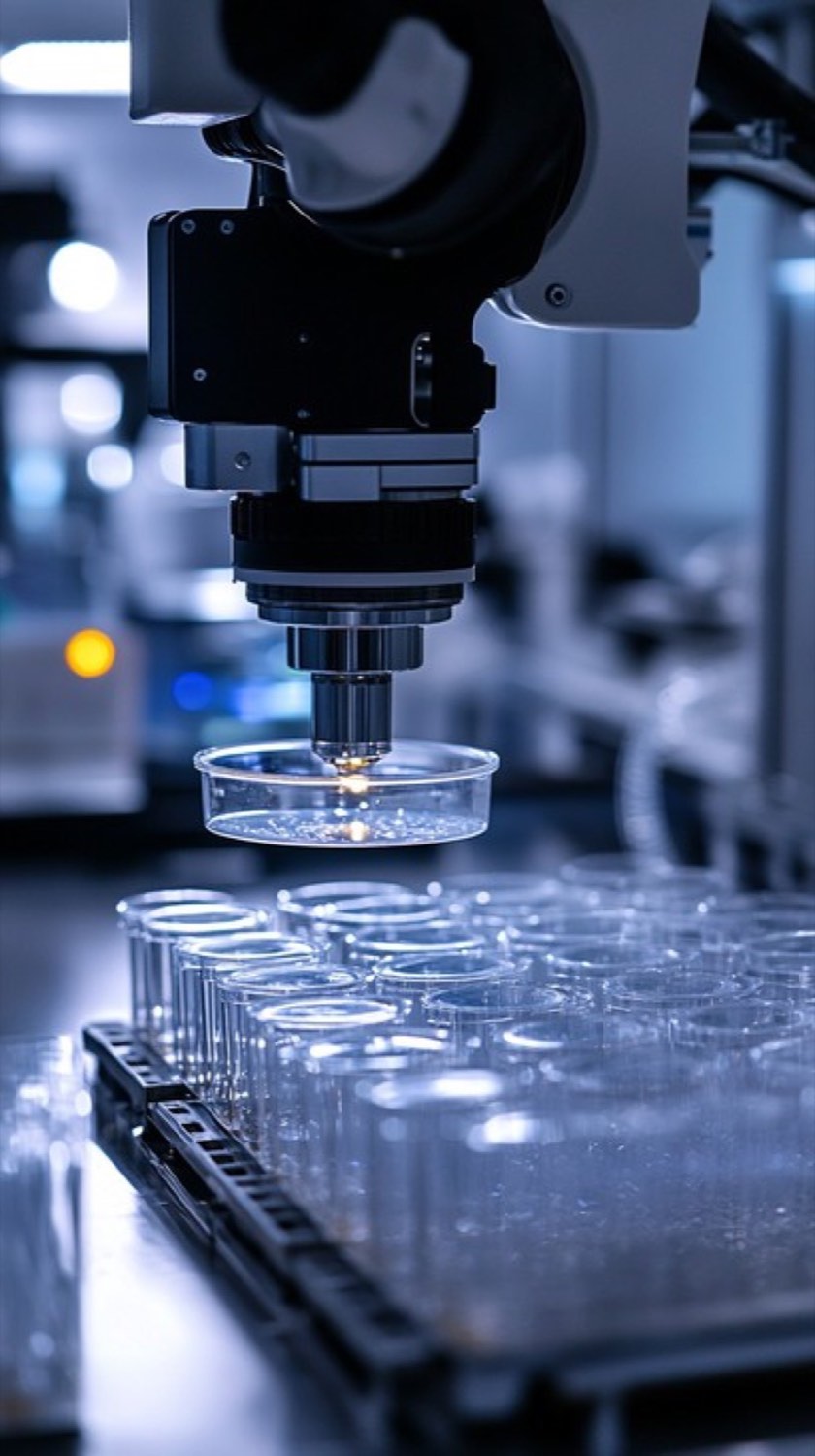
Our technology centre brings our development capability together in one place, combining formulation chemistry with application engineering and analytical capability. Development starts from an identified press-room need, and every concept is qualified on a customer press before it is offered.
We work with raw-material suppliers, converters and brand owners, because an ink that is right in the laboratory and wrong on the press has solved nothing.
Our capability
Formulation Science
Binder, pigment and initiator chemistry developed in house.
Analytical
Migration, cure, rheology and resistance measured, not estimated.
Press Validation
Every concept qualified on a production press before release.
Partnership
Development with suppliers, converters and brand owners together.
Want to talk about a development?
If you have a press-room problem that the current range does not solve, tell us about it.

Science Technology Innovation & Application. Printing inks and coatings for packaging, label and graphic printing since 2006.
Contact Us
E105, GNEPIP, Industrial Area Site-5,
Greater Noida, Uttar Pradesh 201306, India
+91-8750051884
sales@ufindustries.com
https://ufindustries.com