Products
UV Offset Inks
Offset lithographic inks that cure on the sheet in a fraction of a second, so a job can be printed, coated, die-cut and glued in the same shift.
UV and LED curing inks
Litho quality, dry at the delivery
UV offset is conventional lithography with the drying step taken out. The ink travels through the same roller train, splits on the same plate against a dampening film and transfers by blanket to the sheet. What it does not contain is oil or solvent. It is an almost 100 % solids system of acrylate monomers, oligomers and pigment: it does not dry in the duct, and it polymerises only when photoinitiators absorb UV energy. The film goes from wet to solid in a fraction of a second under the lamp. Almost nothing evaporates — cure weight loss is small rather than zero, since photoinitiator cleavage leaves some volatile fragments behind — and on a coated stock very little of the film soaks in.
The reason a printer moves to it is time and finish. A conventional sheet-fed ink dries by absorption and oxidation over hours, which means spray powder, set-off, a pile that has to stand, and a limit on how soon the sheet can be coated, foiled, die-cut or folded and glued. A UV sheet arrives in the delivery finished. Powder can come off the press entirely, so the powder does not contaminate the coater, mark the foil or dull the die. Because the ink does not rely on absorption, hold-out on coated stock is high: densities are reached at a lower film weight, dot gain is lower and the same ink prints on stock that has nowhere for a solvent to go — metallised board, synthetic paper, treated or primed plastics sheet. On uncoated and absorbent stock the picture changes: the sheet does take ink, and a heavier film is needed for the same density.
Against that, the press has to be set up for it. UV inks are more polar than oil-based inks and the water window is narrower, so the fount must be UV-stable and the ink and water balance has to be held closer. The acrylate monomers that make the ink cure will swell nitrile rubber, so rollers and blankets must be EPDM and the wash-up solvent has to suit both. Film weight sits at a typical 1.0 to 1.5 g/m² on coated board. And cure is a question of delivered dose, not of how many lamps are fitted — a point that decides adhesion, rub resistance, odour and, on food packaging, migration.
The range here is two products. Uniforce-250 is the conventional UV offset ink, cured under medium-pressure mercury lamps, which emit across the band and cure from the surface down. Unimax 400 is the UV LED ink for 385 to 405 nm arrays; that narrower, longer-wavelength energy penetrates the film and cures from the substrate up, leaving the oxygen-inhibited surface to cure last, so the photoinitiator package and the irradiance at the sheet have to be chosen for surface cure rather than depth. Both are formulated on heavy-metal-free pigments with raw materials selected to the EuPIA Charter and its exclusion list, and both are offered as low-migration grades where the job is food or pharmaceutical packaging. What makes a grade low-migration is how it is built — the exclusions, the photoinitiator chemistry and the cure it is run at. What makes a finished pack compliant is a migration assessment on that pack, which we will carry out on request.
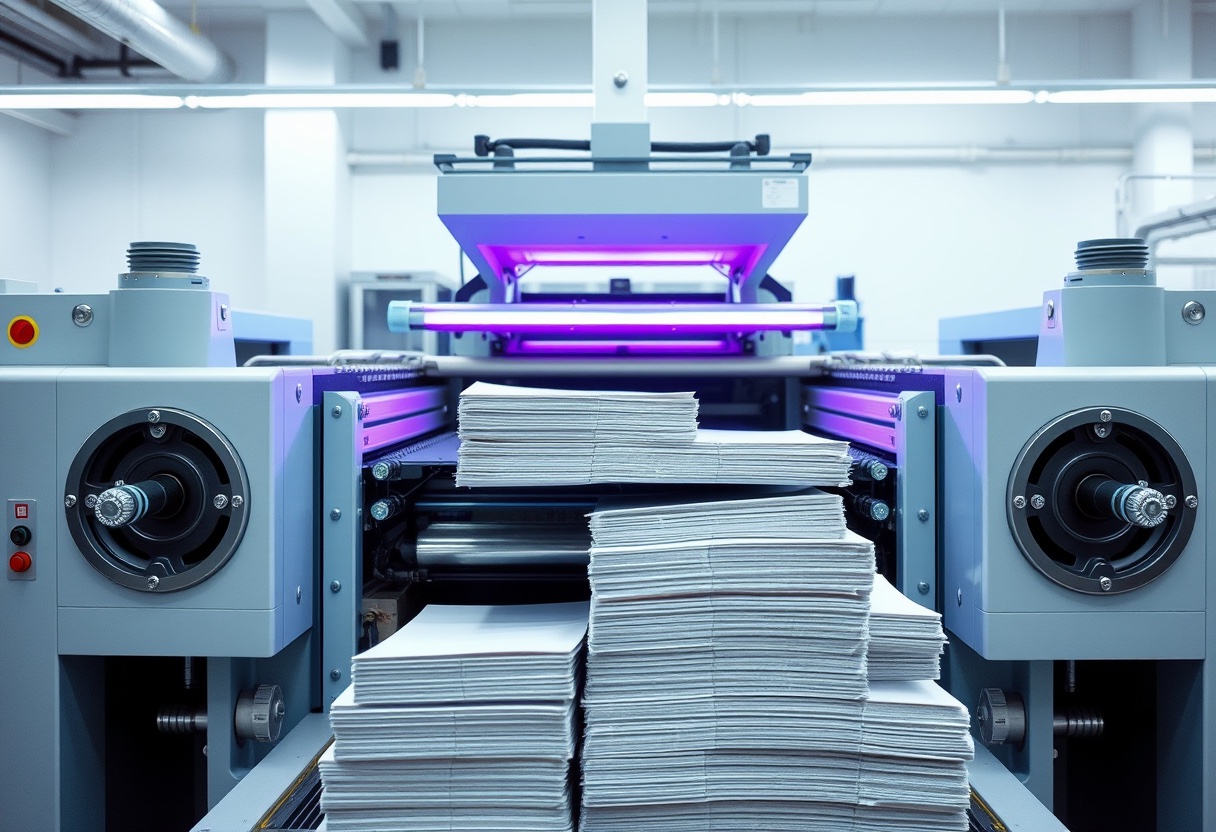
The range
Two base products — Uniforce-250 for mercury-cured presses, Unimax 400 for LED — and the variants built on them. The variant names used here are the names used on the two product pages.
Uniforce-250 — mercury UV offset
Conventional UV offset for medium-pressure mercury lamps, including doped lamps where a heavier film needs cure at depth. Mercury emits broadband, including short-wave UVC absorbed at the top of the film, so cure runs from the surface down and the risk sits against the substrate. The general-purpose series for folding carton, commercial sheet-fed and sheet-fed label work on coated board. Lamps 120–200 W/cm; at the substrate 80–150 mJ/cm² for process colours, 120–200 mJ/cm² for dense black and 150–250 mJ/cm² for opaque white and metallics. Grades: process UF250-Y10 / M10 / C10 / K10, dense black UF250-K11, mixing bases UF250-B01 to B12, transparent white UF250-T00, opaque white UF250-W20, plastics UF250PL, metallics UF250MT-S30 and UF250MT-G30, low migration UF250LM. Shelf life 12 months from manufacture, unopened, at 15–25 °C.
Unimax 400 — UV LED offset
UV LED offset for 385–405 nm arrays: the same lithographic behaviour on press, with no lamp warm-up, no ozone extraction and no idle power, since the array draws current only while the press is running. That narrower, longer-wavelength energy penetrates the film, so cure runs from the substrate up and the oxygen-inhibited surface hardens last — the photoinitiator package and the irradiance at the sheet are chosen for surface cure rather than depth, and there is no short-wave line to beat the oxygen, which is why the LED dose is not lower than the mercury dose for the same ink. Peak irradiance 8–12 W/cm² for process colours and 12–16 W/cm² for opaque white and dense black, measured at the substrate plane and not at the emitting window; 80–150 mJ/cm² in band at the substrate for process colours and 150–250 mJ/cm² for opaque white and dense black. Grades: UMX-401 to UMX-404 process, UMX-405 opaque white, UMX-406 dense black, UMX-411 to UMX-425 mixing bases, UMX-426 blending varnish, UMX-400NW narrow web, UMX-400LM low migration. Shelf life 9 months from manufacture, unopened, at 15–25 °C, out of daylight and stray array light.
Process — UF250-Y10 / M10 / C10 / K10 and UMX-401 to UMX-404
The four-colour process set in either series. Transparent, high-strength pigments so that density comes from a thin film at 1.0–1.5 g/m². Formulated to the ISO 2846-1 aim colorimetry as closely as a 100 % solids acrylate allows, and capable of ISO 12647-2 solid values on the agreed stock — that printed result belongs to the printer and the press, not to the ink. Bench tack 13 ± 2 (IGT-type tack meter, 400 rpm, 30 °C, 1.3 cm³ charge, read at 60 s), with the ladder published as a separate specification and graduated to descend through the units for wet-on-wet trapping; the sequence is set with the job. Light fastness on the full-tone unvarnished film, ISO 12040 filtered xenon arc against ISO 105-B02 blue wool references: yellow 4–5 in both series, magenta 4–5, cyan 8, black 8. Tints and process builds lose one to two steps.
Bases — UF250-B01 to B12 and UMX-411 to UMX-425
Mixing bases for spot colours, built on the same oligomer and photoinitiator platform as the process set of their own series, so a matched shade cures in the same window and a spot colour does not force a different lamp setting. The two systems genuinely differ and are not interchangeable: Uniforce-250 has twelve bases — Yellow, Orange, Warm Red, Rubine, Rhodamine, Purple, Violet, Reflex Blue, Process Blue, Green, Black and Transparent White — and Unimax 400 has fifteen — Lemon Yellow, Golden Yellow, Orange, Warm Red, Red, Rubine, Rhodamine, Purple, Violet, Reflex Blue, Process Blue, Green, Black, Mixing White and Transparent White extender. All are on heavy-metal-free pigments. Light fastness is a property of the pigment class and is quoted per base rather than per system: in Unimax 400, Reflex Blue UMX-420 is Blue Wool 5–6, Purple UMX-418 and Violet UMX-419 are 4–5 and Rhodamine UMX-417 is 2–3, so the individual base is checked before it is specified for display work. Shades are blended and verified in the laboratory against the customer’s own approved drawdown or a published colour reference, with ΔE*ab ≤ 2.0 as the agreed match tolerance, CIELAB D50/2°, ISO 13655 M1, on the customer’s own substrate at the agreed film weight. Corrections are made in the laboratory rather than on press, where additions dilute the cure package.
Opaque White — UF250-W20 and UMX-405
High-opacity white for metallised board, film and clear label stock, run at 1.8–2.5 g/m² or as a double hit. Titanium dioxide has a far higher refractive index than the binder around it, so it scatters light strongly at every pigment interface — that is where the opacity comes from, and it is also why white is the cure-limiting colour in either series: 150–250 mJ/cm² at the substrate under mercury, and 150–250 mJ/cm² in band at 12–16 W/cm² peak irradiance under LED, where rutile’s absorption edge near 405–410 nm takes part of the array’s output as well as scattering it. White work is normally moved to 395 or 405 nm emitters rather than given more of a shorter wavelength, and UF250-W20 is designed for interdeck cure rather than the end-of-press lamp alone.
LM — Low Migration — UF250LM and UMX-400LM
The low-migration grade in each series, for food, pharmaceutical and other sensitive packaging. Raw materials selected under the EuPIA Charter; TPO excluded across the range; ITX and benzophenone excluded here; high-molecular-weight and multifunctional acylphosphine oxides with polymeric amine synergists, carrying reactive groups so the initiator binds into the network during cure; monomer selection weighted to higher-functionality acrylates; heavy-metal-free pigments. Full cure at the specified dose is part of the specification rather than an optional extra, because the species that move through a board wall are unreacted monomer and free photoinitiator — on UF250LM that means 150–250 mJ/cm² on the process colours, typically 1.5 to 2 times the standard series. Migration assessed on the finished pack, on request.
PL — Plastics — UF250PL
For UV-suitable plastics: treated PP and PE, PET, rigid PVC and styrene sheet. Adhesion is a surface-energy problem before it is an ink problem, so the stock is corona-treated or primed to ≥ 40 mN/m verified at the press rather than taken from the film certificate, and adhesion is checked by cross-hatch and tape 24 hours after the run, not at the delivery. Cross-hatch on treated plastics is typically classification 0–1 to ISO 2409 — class 1 being detachment of not more than 5 % of the lattice area — at the stated dose and film weight. Treatment level, ageing and slip or anti-block additives differ between suppliers and between reels, so the result is confirmed on the customer’s own stock before it is written into a specification.
MT — Metallics — UF250MT-S30 Silver and UF250MT-G30 Gold
Silver and gold shades for sheet-fed UV. Leafing pigments have to orient at the surface to look metallic, so they need a heavier film than a process colour — 1.5–2.5 g/m² — and a coating over the top to protect the leaf; specify a matched UniCure coating with them. The two shades are not one specification: the leafing aluminium silver UF250MT-S30 runs at a specific gravity of 1.10–1.25 g/cm³, while the gold UF250MT-G30, built on brass (gold bronze) flake whose own density is about 8.5 g/cm³, runs at 1.35–1.65 g/cm³.
NW — Narrow Web — UMX-400NW
For the offset decks of narrow-web combination presses running offset alongside UV flexo units. Tack 10 ± 2 and a working film of 0.8–1.2 g/m², against 13 ± 2 and 1.0–1.5 g/m² on the sheet-fed grade, because a thin, often unsupported face material picks or distorts at a sheet-fed tack. Where one colour standard or one regulatory profile is wanted across both unit types, that has to be established for the specific pair of ranges rather than assumed.
Product data
| Process | Offset lithography, sheet-fed, and the offset decks of narrow-web combination presses. Conventional mercury UV presses and LED UV presses. |
|---|---|
| Range | Uniforce-250 for medium-pressure mercury curing and Unimax 400 for LED at 385–405 nm. Order codes are the product-sheet codes, which are what an order has to carry: Uniforce-250 process UF250-Y10 / M10 / C10 / K10, dense black UF250-K11, mixing bases UF250-B01 to B12, transparent white UF250-T00, opaque white UF250-W20, plastics UF250PL, metallics UF250MT-S30 Silver and UF250MT-G30 Gold, low migration UF250LM; Unimax 400 process UMX-401 to UMX-404, opaque white UMX-405, dense black UMX-406, mixing bases UMX-411 to UMX-425, blending varnish UMX-426, narrow web UMX-400NW and low migration UMX-400LM, the LM and NW suffixes carried on the shade number. |
| Cure | Almost 100 % solids radical acrylate polymerisation; nothing to evaporate. Uniforce-250 under medium-pressure mercury or doped lamps rated 120–200 W/cm (about 300–500 W/inch): typical delivered dose at the substrate 80–150 mJ/cm² for process colours, 120–200 mJ/cm² for dense black, and 150–250 mJ/cm² for opaque white and metallics. Unimax 400 under 385–405 nm LED at a peak irradiance of 8–12 W/cm² for process colours and 12–16 W/cm² for opaque white and dense black, measured at the substrate plane and not at the emitting window — a window reading ignores the working-distance loss, which runs at 15–30 % of peak irradiance for 5 mm beyond the specified gap, so it is not a press specification. Typical delivered dose in band at the substrate 80–150 mJ/cm² for process colours and 150–250 mJ/cm² for opaque white and dense black: the same energy as the mercury series, not less. A 385–405 nm array has no short-wave output with which to overcome oxygen inhibition at the surface, so for the same ink the LED dose is equal to or higher than the mercury dose, never lower. White work is moved to 395 or 405 nm emitters rather than given more of a shorter wavelength that the rutile absorbs. Dose is measured with a radiometer carried through the press at running speed and read on the heaviest solid, with the head calibrated for the band the source actually emits — a UV-A 320–390 nm head at a mercury lamp, a 385–405 nm LED-band head at an LED station. A UV-A head at an LED station is calibrated below most of a 395 or 405 nm array and under-reports it. Set the lamp for the hardest colour on the job and log the reading: output falls with lamp hours, dirty quartz and a tarnished reflector long before anything looks different. |
| Film weight | Typical 1.0–1.5 g/m² for process colours on coated board, determined by weighing a cut area of printed against unprinted sheet; 1.8–2.5 g/m² for opaque white and 1.5–2.5 g/m² for metallics, or a double hit. Uncoated and absorbent stock takes ink and needs a heavier film for the same density. |
| Tack and body | Bench tack for a single mid-sequence process ink 13 ± 2 in both series, IGT-type tack meter at 400 rpm and 30 °C with a 1.3 cm³ ink charge, read at 60 s — one charge across the house, because tack read at a different ink charge is not comparable with it. The ladder is a separate specification from the bench value, and the first-down and last-down grades are supplied on their own tack: Uniforce-250 first down 16 ± 1, falling 1–2 points per unit to 12 ± 1 last down; Unimax 400 first down 14–16 to 10–12 last down; Unimax 400 NW 11–12 to 8–9. The sequence is fixed with the job. Viscosity on the Laray falling-rod viscometer at 25 °C, reported at 2 500 s⁻¹: Uniforce-250 45 ± 15 Pa·s with a yield value of 150 ± 50 Pa, Unimax 400 45 ± 10 Pa·s at 150 ± 50 Pa, Unimax 400 NW 35 ± 8 Pa·s at 100–200 Pa. Both tack and body move with train temperature, which is why the ink train is held steady rather than allowed to climb through the run. |
| Substrates | Coated and uncoated paper and board, cast-coated and metallised board, synthetic paper, self-adhesive label stock, and corona-treated or primed PVC, PET, PP and styrene sheet — surface energy ≥ 40 mN/m for Uniforce-250 PL and 40–44 mN/m for Unimax 400, verified with dyne pens or ISO 8296 test inks at the press rather than taken from the film certificate. Adhesion on any synthetic substrate is confirmed by trial, by cross-hatch and tape 24 hours after the run rather than at the delivery. |
| Colour range | Four-colour process set, dense black, opaque white, metallics and a mixing base system for spot colours in each series. The two base systems are not the same and are not interchangeable: Uniforce-250 has twelve bases, UF250-B01 to B12 — Yellow, Orange, Warm Red, Rubine, Rhodamine, Purple, Violet, Reflex Blue, Process Blue, Green, Black and Transparent White; Unimax 400 has fifteen, UMX-411 to UMX-425 — Lemon Yellow, Golden Yellow, Orange, Warm Red, Red, Rubine, Rhodamine, Purple, Violet, Reflex Blue, Process Blue, Green, Black, Mixing White and Transparent White extender. The process set is formulated to the ISO 2846-1 aim colorimetry as closely as a 100 % solids acrylate allows, and is capable of ISO 12647-2 solid values on the agreed stock; the printed result is the printer’s, reached on their press, stock and process control, and is not a property of the ink. Spot shades are matched to the customer’s own approved drawdown or to a published colour reference, with ΔE*ab ≤ 2.0 agreed as the match tolerance rather than published as a property, CIELAB D50/2°, ISO 13655 measurement condition M1, read on the customer’s own substrate at the agreed film weight. |
| Gloss | Read on the printed substrate rather than on a drawdown card, ISO 2813, 24 h after cure, because the stock under the film carries much of the result. 20° is the discriminating geometry for a high-gloss UV film; 60° is the mid-gloss angle and separates high-gloss films poorly; 85° is for matt and sheen. The two series are quoted separately, because one pair of numbers cannot cover both: on a fully cured process solid at 1.2 g/m² on gloss-coated board, Uniforce-250 typically reads 55 ± 10 GU at 20° and 80 ± 8 GU at 60°, and Unimax 400 typically reads 40 ± 10 GU at 20° and 65 ± 10 GU at 60°. The LED film reads lower because it cures from the substrate up and the surface finishes last against atmospheric oxygen, which is where gloss is made. Under a UniCure high-gloss UV overprint varnish at 2.8–3.2 g/m² the 20° reading rises to 80–90 GU. Matt, uncoated and absorbent stocks read lower. |
| Press consumables | EPDM rollers and UV-compatible blankets throughout, UV-resistant photopolymer plates baked where the run length calls for it, and a wash-up solvent that suits both. UV-stable fount, IPA-free or below 5 % IPA, run at pH 4.8–5.5. Conductivity is specified as an increment over the incoming water and not as an absolute figure: base water + 900–1 300 µS/cm at 20–25 °C, which on the 8–12 °dH make-up water this range specifies — roughly 140–210 ppm as CaCO₃, about 250–400 µS/cm — gives about 1 200–1 700 µS/cm in total. Log the incoming water reading beside the fount reading, because the absolute number means nothing without it, and hold the running value within ±150 µS/cm of the set-up figure. Log conductivity and pH at the start of the shift rather than judging them from the sheet. Dampening chilled to 10–14 °C at the fount tank. Ink train temperature controlled and held steady at 28–32 °C, with ink in the duct at 22–28 °C. |
| Low migration | Uniforce-250 LM (UF250LM) and Unimax 400 LM (UMX-400LM, the LM suffix on any shade) are the low-migration grades. Across the whole range TPO is excluded — reprotoxic category 1B under CLP by the 19th ATP, applying from September 2025, and on the EuPIA exclusion list — pigments are heavy-metal-free and raw materials are selected under the EuPIA Charter. The LM grades additionally exclude ITX and benzophenone, are initiated by high-molecular-weight and multifunctional acylphosphine oxides with polymeric amine synergists, and weight monomer selection to higher-functionality acrylates. Full cure at the specified dose is part of the specification: Uniforce-250 LM needs 150–250 mJ/cm² on the process colours, typically 1.5 to 2 times the standard series, because a high-molecular-weight initiator and a polymeric synergist are less mobile and carry fewer absorbing groups per unit weight. No migration figure is quoted for the ink on its own: what moves through a pack wall is decided by cure state, ink load, substrate and barrier, set-off in the pile, and the filling and storage of the pack. Migration is therefore assessed on the finished pack, on request. |
| Pack sizes and storage | 1 kg and 2.5 kg tins and 2 kg cartridges for automatic ink feed systems, with 5 kg pails; 20 kg pails on Unimax 400 process colours only. The 2 kg pack is a cartridge and not a can. Store unopened in the original closed containers at 15–25 °C, away from daylight, stray UV, heat and ignition sources; do not store above 30 °C. Shelf life is quoted per series rather than as one house figure: 12 months from the date of manufacture for Uniforce-250 in unopened containers, and 9 months for Unimax 400, whose long-wave initiator package absorbs in a band that daylight contains. A 100 % solids acrylate is limited by slow thermal and light-initiated polymerisation rather than by evaporation, which is why light exclusion is a storage condition and not a precaution. Not frost-sensitive: bring to room temperature and stir back before use. Keep part-used ink in a closed opaque container and use it first; do not return ink from the duct to the original can. |
| Documentation | Technical Data Sheet, Safety Data Sheet and Regulatory Summary for every grade. Matching UV and LED overprint coatings from the UniCure range for coater or offset-duct application. |
Compliance and standards
- Raw materials selected to the EuPIA Charter
- TPO-free
- ITX- and benzophenone-free in low-migration grades
- Heavy-metal-free pigments
- Low-migration grade available
- Migration assessment on request
- REACH-registered raw materials
White paper
Ink, water and the rubber in the press
A UV offset ink is more polar than an oil-based one, and it emulsifies water differently. The working window between scumming and over-emulsification is narrower, so the fount matters as much as the ink. It has to be UV-stable — free of components that react with acrylate monomers or that build in the ink as the day goes on — and it is normally run IPA-free or at low IPA, with surfactants and glycol ethers doing the wetting instead. Run too much water and the symptoms are specific: gloss falls away, cure gets softer because water in the film interferes with the polymerisation, and the ink starts to tint. Run too little and the non-image area picks up. Conductivity and pH should be logged at the start of the shift rather than judged from the sheet.
The second change is mechanical. The monomers that make the ink cure are solvents for nitrile rubber. An NBR roller will swell, go soft, change its stripe and eventually fail, so a UV press runs EPDM rollers and UV-compatible blankets throughout, with wash-up solvent chosen to suit both. After a roller change the settings have to be reset, not assumed, because durometer and diameter are not the same as the rubber that came out. Plates should be UV-resistant photopolymer, baked where the run length calls for it. A press that alternates between conventional and UV work needs either a full changeout or a dedicated ink train; half measures show up as roller stripping and as contamination that will not wash out.
Roller temperature control earns its keep here. UV inks are shear-thinning and they heat in the train, and viscosity moving through the run drags ink and water balance with it. Holding the train at a steady temperature, typically in the high twenties Celsius, keeps the ink behaving the same at the end of the run as at the start. For wet-on-wet trapping the tack sequence should still descend unit to unit; where a heavy solid has to trap cleanly, interdeck pinning is the usual answer rather than more ink.
Finish is measured, not admired. Gloss on a UV film is a specular reading against a stated geometry, and the geometry has to suit the level: 20° discriminates between high-gloss films, 60° is the mid-gloss angle and 85° is for matt and sheen. Take the reading on the printed substrate rather than on a drawdown card, because the stock under the film carries much of the result.
White paper
Dose, depth and what happens after the lamp
Cure is set by two numbers: irradiance, the power arriving at the sheet in W/cm², and dose, the energy delivered over the exposure in mJ/cm². Neither can be read by eye. A mercury lamp puts out a broad spectrum including short-wavelength UVC, which is absorbed at the top of the film, so cure runs from the surface downwards and the risk is an undercured layer against the substrate. An LED array at 385 to 405 nm has no UVC at all; that energy penetrates, so cure runs from the substrate upwards and the last part to harden is the surface, where atmospheric oxygen quenches the reaction. The failure modes are therefore opposite ends of the same film. Mercury tends to fail as poor adhesion and solvent sensitivity underneath; LED tends to fail as surface tack, marking and odour. That is why LED grades need a photoinitiator package chosen for surface cure and an array that actually delivers its rated irradiance at the working distance.
Film weight and pigment both change the arithmetic. At a typical 1.0 to 1.5 g/m² an offset film is thin and cures readily, but pigment competes with the photoinitiator for the same photons. Opaque white scatters, black absorbs, and some yellows are effectively transparent to UV while others are not, so the dose that cures a yellow solid will not necessarily cure a white laid down at twice the film weight. Lamps also age: output falls long before the lamp looks different, and dirty quartz or a tarnished reflector costs more than most printers assume. A radiometer passed through the press at intervals, with the readings kept, is the only way to know what the sheet is getting.
After the lamp, two practical consequences. Over-cure embrittles the film, and a brittle film cracks at a crease or a scored fold, so more dose is not automatically safer. And a fully cured acrylate film gives adhesive very little to key into, which is why glue flaps are kept free of ink and coating rather than trusted to bond. On packaging, cure state is also the first control on migration: the species that move through a board wall are unreacted monomer and free photoinitiator, so an undercured film is a compliance problem before it is a print-quality problem. A thumb-twist or a solvent rub is a useful shop-floor indicator of surface cure and nothing more — it is not a migration test, and it does not replace the analysis behind a Regulatory Summary.
Related products
Don't see what you're looking for?
Please feel free to call us. We colour-match to any request and develop inks around your press-room need.

Science Technology Innovation & Application. Printing inks and coatings for packaging, label and graphic printing since 2006.
Contact Us
E105, GNEPIP, Industrial Area Site-5,
Greater Noida, Uttar Pradesh 201306, India
+91-8750051884
sales@ufindustries.com
https://ufindustries.com