Knowledge
Technologies
The curing systems, chemistries and process controls behind every product we make — set out in enough detail to be useful on the press.
Home › Technologies
How it works
Chemistry you can ask questions about
Every product we make rests on a small number of decisions: how the film is fixed, what carries the pigment until it is, what holds the film to the substrate, and how the colour is controlled and kept. Those decisions are what a technology is. They set the speed you can run, the substrates you can print, the energy the press draws, the resistance the pack has and the regulatory work that follows.
These pages are written for the person who has to make the job run. Each one says what the chemistry actually does, gives the process window with the method that produced each number, and ends with the faults the technology really presents with and what to change first. Where a full technical paper exists it is linked from the page.
One caveat throughout: every figure on these pages is typical for the class of product, quoted with its method. The numbers that govern a supply are the ones on the Technical Data Sheet for the grade you buy, and the numbers that govern a food-contact pack are the ones measured on that pack.
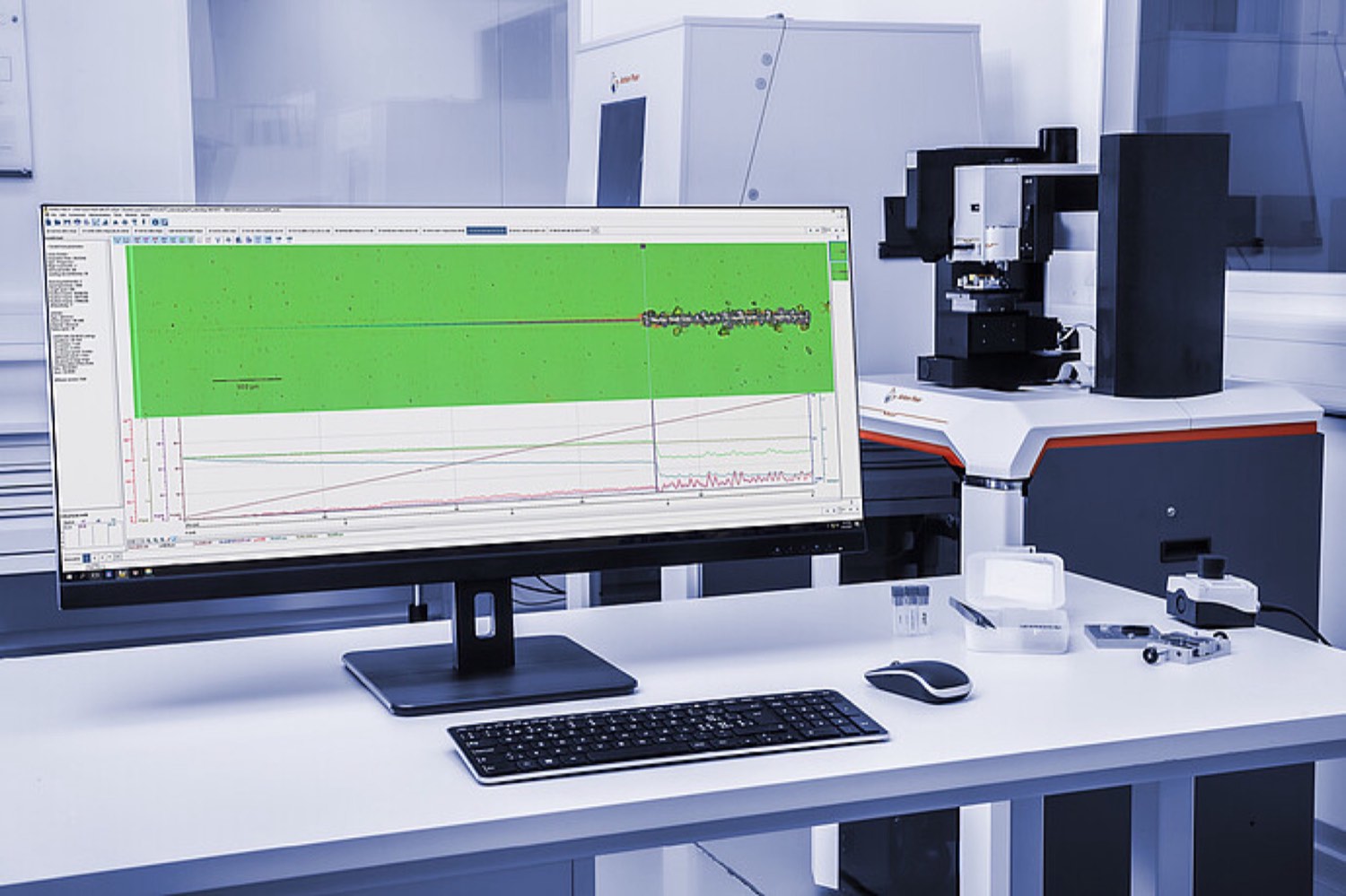
Our core technologies
Seven areas that decide how an ink behaves on your press.
UV Curing
Broadband mercury cure. Dose, oxygen inhibition and what the lamp actually has to deliver.
LED-UV Curing
385 to 405 nm. Cool cure, lower load, and the wavelength choice that decides cure under white.
Water-Based Technology
Binder balance, pH as the control variable, drying capacity and resolubility.
Solvent-Based Technology
Resin choice, solvent balance, residual solvent and lamination bond strength.
Low Migration Technology
The three routes into food, the limits that apply, and what the press has to hold.
Colour Matching
Measured standards, stated conditions, expanded gamut and Blue Wool light fastness.
Special Effects
Drip-off, raised crystal, haptic sand, soft touch, cold foil and colour change.
The four film-forming routes, side by side
Most specification arguments come down to choosing between these. The rows are the ones that actually decide it.
Scroll the table sideways to compare all four routes.
| Conventional UV | LED-UV | Water-based | Solvent-based | |
|---|---|---|---|---|
| How the film is fixed | Free-radical cure under broadband mercury, 200–450 nm | Free-radical cure under a narrow band at 385, 395 or 405 nm | Evaporation of water and amine, then coalescence of the resin | Evaporation of an organic solvent blend |
| What leaves the film | Essentially nothing — close to 100 % solids | Essentially nothing — close to 100 % solids | Water plus a small co-solvent and amine fraction | The whole solvent blend, 50–70 % of what is applied |
| Energy at the press | High. Medium-pressure lamps at 120–200 W/cm, plus ozone extraction and chilling | Low. Roughly 30–70 % less connected load, no warm-up, no idle burn | Moderate to high. Water has about five times the latent heat of ethyl acetate | Moderate. Fast release, but the dryer and the abatement system both draw |
| Heat at the substrate | 60–100 °C web rise without chilling — the limit on thin film | 10–25 °C — thin PE, OPP, shrink film and tube laminate become practical | 50–70 °C hot air, applied over dwell rather than instantly | 40–80 °C rising through the tunnel |
| Typical film weight | 1.0–1.5 g/m² offset, 1.2–2.0 flexo, 1.5–3.0 coating, 4–12 screen | 1.0–2.0 g/m² narrow web, higher for opaque white | 1.5–3.0 g/m² dry, higher on absorbent stock | 1.2–2.5 g/m² dry for gravure colours |
| Substrate range | Paper, board, label stock, treated plastics; heat limits thin film | As conventional UV, plus the thin and heat-sensitive films mercury cannot run | Paper, board, corrugated, cup stock; film only with good treatment | Treated PET, BOPP, PE, CPP, nylon, metallised film, foil, paper |
| The control variable | Measured dose and peak irradiance at the substrate | Dose, working distance and the initiator matched to the array wavelength | pH, then viscosity — in that order | Solvent balance and residual solvent in the finished reel |
| Where it wins | Resistance, instant handling, high gloss, heavy screen and effect films | Heat-sensitive substrates, energy, no mercury and no ozone | Paper and board work, corrugated post-print, low VOC, food-adjacent | Lamination bonds, wide film latitude, high-speed gravure |
| What to watch | Oxygen inhibition at the surface, lamp ageing, heat on thin film | No 254 nm line, so surface cure is a chemistry problem; cure under opaque white | Drying capacity, humidity, and resolubility traded against water resistance | Solvent retention, odour and taint, emissions abatement |
| Our ranges | UniCure UV flexo, UV coatings, Uniforce-250 offset, Unipress letterpress | UniCure LED 395, Unimax 400 offset, Unipress 30 LED | Water-based flexo and gravure, aqueous coatings, functional coatings | Solvent-based flexo and gravure inks, PU lamination inks |
Figures are typical for each class and are quoted with the method on the technology page concerned. Screen, pad and offset processes cut across these routes: the same press can run more than one.
Process control
How a claim on these pages is supported
A technology page is only useful if the numbers on it can be checked. Five measurements do most of that work, and they recur on every page in this section.
- Cure dose and peak irradiance. Band-calibrated radiometer passed through the press at running speed with the job on the machine — UV-A for mercury, an LED-band head for an array. A lamp percentage on the console is not a measurement.
- Surface energy. Test inks to ASTM D2578 or ISO 8296 on the reel about to be run, within the shift. Corona treatment decays in store and slip additive blooms, so the film supplier’s certificate is not a substitute.
- Cure and resistance. MEK double rubs to ASTM D5402 at 1 kg for cure; cross-cut adhesion to ISO 2409 read 24 h after the run at 23 °C and 50 % RH; Sutherland rub for scuff.
- Colour. Spectrophotometric ΔE00 against a retained master, with geometry, illuminant, measurement mode and backing all declared, on the production substrate at the production film weight.
- Migration and residual solvent. Simulant testing to Regulation (EU) 10/2011 and Tenax® at 40 °C for 10 days for dry foods; static headspace GC for residual solvent in a laminated construction. Both are run on the finished pack, because that is the only place the answer exists.
Choosing a technology
Start from the constraint you cannot move, not from the technology you would prefer.
I print labels on narrow web
UV or LED-UV, and increasingly LED. LED is the answer where the stock is thin, heat-sensitive or shrink film, where the press stops often enough that a mercury lamp’s idle burn is expensive, or where the press room wants to be rid of ozone extraction and mercury handling. Conventional UV remains the answer for heavy effect and screen work that needs penetrating wavelengths. Both routes run low-migration sets where the label goes on food.
I print flexible packaging for lamination
Solvent-based gravure with PU-based lamination inks, for the bond strength and the thermal tolerance a pouch needs. The controls that decide success are solvent retention measured by headspace GC on the finished reel, and bond strength read by T-peel after the pack’s own ageing condition rather than at 24 h. Water-based gravure covers the paper-based side of the same market.
I print paper, board or corrugated
Water-based, almost always. The substrate is absorbent, which does half the drying, the VOC position is good and the cost base is right. The two things that decide whether it runs well are dryer capacity — air volume and extraction, not temperature — and pH discipline on the press. Aqueous coatings finish the job in gloss or matt.
I print folding carton and need resistance and finish
UV offset with UV coatings, and for heavy decorative work, screen-applied effect coatings. Uniforce-250 covers the conventional route; Unimax 400 the LED route where board heat or energy matters. Specify the coating at the same time as the ink: drip-off, soft touch and structure effects are coating decisions that constrain the ink beneath them.
I print tubes and lamitube laminate
UV and LED letterpress. Unipress 30 LED is built for the treated polyethylene skin of ABL and PBL laminate, where heat would distort the web and where adhesion depends on treatment that has to be verified at the press. The cap torque, heading and filled-product resistance belong to the finished tube and are qualified on the pack.
My constraint is energy or the press-room environment
LED-UV removes warm-up, idle burn, ozone extraction and mercury disposal, and typically 30 to 70 % of the connected load. Water-based removes the solvent inventory and the abatement plant. Neither is a straight swap: LED needs inks matched to the array wavelength, and water-based needs drying capacity the press may not have. Both are worth a trial with measurement rather than a change on paper.
My constraint is food contact
Then the technology choice is downstream of the migration assessment, not upstream of it. Start with the structure, the food and the contact conditions; work out whether there is a functional barrier in the path and what the set-off case looks like; then choose the ink and fix the cure specification around the answer. The Low Migration page sets out how that runs.
At a glance
Measured, not asserted
Every figure on these pages carries the method that produced it.
Four routes
UV, LED-UV, water-based and solvent-based, plus the controls common to all of them.
Papers behind them
Twelve technical papers carry the detail these pages summarise.
Technical service
Send the substrate, the press and the constraint, and we will specify against it.
Go deeper
Where the detail behind these pages lives.
White Papers
Twelve technical papers for the detail behind these pages.
Innovation Roadmap
Twelve concepts for 2026 to 2031.
Research & Development
How a concept becomes a released product.
Technical Data Sheets
Measured properties for every grade.
Don't see what you're looking for?
Please feel free to call us. We colour-match to any request and develop inks around your press-room need.

Science Technology Innovation & Application. Printing inks and coatings for packaging, label and graphic printing since 2006.
Contact Us
E105, GNEPIP, Industrial Area Site-5,
Greater Noida, Uttar Pradesh 201306, India
+91-8750051884
sales@ufindustries.com
https://ufindustries.com